IP Monetization Outlook: Key Insights for Legal Teams
Patent monetization has evolved into a mainstream corporate strategy, with companies increasingly using enforcement and divestiture to unlock value from underutilized IP portfolios, even as cost, risk and uncertainty remain significant barriers. Legal finance is helping overcome those barriers by providing capital, transferring enforcement risk and enabling companies to monetize patents while preserving resources for core growth and innovation.
5 October 2026 by Burford Capital
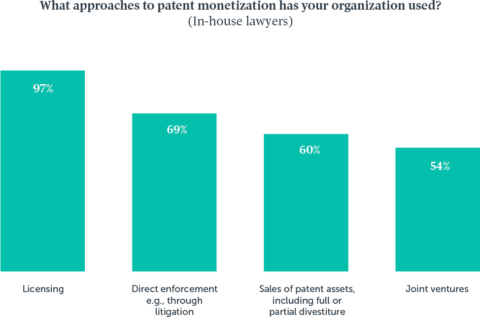
Over the past decade, business leaders and legal teams at large global companies have increasingly embraced patent monetization as a strategic financial tool, not a defensive tactic. Indeed, recent research reveals that 77% of in-house lawyers and 83% of law firm partners view it as a legitimate business practice and driver of innovation.
According to Burford Capital’s 2025 Patent Monetization Survey, nearly 70% of in-house counsel say their organizations are more likely to monetize patents today than they were ten years ago, while 73% report growing revenues from these efforts. Conducted by GLG among 300 IP counsel and law firm partners across Europe, North America and Asia, the survey underscores expanding opportunities to unlock IP value through monetization.
Setting the stage
Corporate patent monetization has accelerated, with recent sales by Ericsson, Philips, Siemens, Dolby, GE, LG Chem and NXP underscoring the market’s growing maturity following more than a decade of headline-generating transactions including Round Rock’s launch with Micron patents, the Apple-led consortium’s $4.5 billion Nortel acquisition, and Kodak’s digital imaging sale.
Furthermore, patent monetization is no longer geographically concentrated:
- Europe continues to expand following the launch of the Unified Patent Court (UPC), with 74% of in-house lawyers expecting increased enforcement activity and 41% citing cost efficiency as the court’s main advantage.
- Asia is emerging as a growth region for IP-backed finance and litigation funding, with Japan, South Korea and other nations offering fertile ground for future monetization strategies.
- The United States remains the most mature and dynamic market for patent monetization, with 45% of law firms ranking it as the top jurisdiction among eight regions for growth potential for its strong legal infrastructure, active litigation environment and reliable enforcement mechanisms.
Together, these developments reflect a broader shift: Patent monetization has become an established component of corporate IP strategy, supported by increasingly mature financial and legal frameworks across markets.
Underused assets, untapped value
Despite growing momentum in patent monetization, many corporations continue to leave substantial value untapped. According to the survey, 79% of in-house lawyers believe that more than a quarter of their company’s patent portfolio remains underutilized.
Each patent can cost about $50,000 to prosecute, and requires ongoing maintenance fees that often reach seven figures for large portfolios. Yet many organizations fail to generate meaningful returns from these investments. The result is twofold: Companies miss potential revenue and tie up capital that could otherwise support growth initiatives like R&D or market expansion.
The opportunity costs of underused patents—lost revenue, slower market entry and reduced market share—are hard to quantify but strategically significant. Leading companies are closing this gap by embedding monetization into IP strategy, transforming dormant assets into liquid capital through licensing, enforcement and divestiture.
The cost—and opportunity—of enforcement
Pursuing patent monetization through direct enforcement—litigation against infringers to recover damages or reach settlements—offers clear returns but is costly and complex, and many companies hesitate to litigate despite the promise of significant recoveries given the high costs, lengthy timelines and uncertain outcomes. Judicial discretion, the challenge of proving infringement and exposure to countersuits all add to this hesitation.
Survey data reinforces these concerns: Both in-house and law firm lawyers cite outcome uncertainty as the leading barrier, with 72% of firms naming cost and risk as key deterrents. Those concerns are well founded—the American Intellectual Property Law Association estimates that patent cases exceeding $25 million in value cost about $3.6 million to litigate, while Burford’s experience shows high-value disputes ($50 million or more) often require $10 million or beyond.
To overcome these challenges, companies are increasingly using legal finance to:
- Finance patent enforcement—enabling companies and law firms to pursue infringement claims without upfront costs, allowing patent holders to protect their IP rights even against better-funded opponents.
- Finance patent divestitures—unlocking liquidity by selling non-core patents. Burford provides capital for acquisitions, legal fees and working capital to support future monetization efforts.
- Provide capital and expertise—bringing industry insight to structure deals, assess risk and maximize patent value, driving stronger outcomes in both divestitures and litigation.
Nearly eight in ten in-house lawyers report they have used, are exploring or plan to use legal finance to support enforcement or other monetization strategies. By shifting cost and risk, legal finance enables companies to act on strong infringement claims that might otherwise remain untested—unlocking IP value while preserving capital for innovation and growth.
Selling smart: The rise of patent divestiture
Corporate patent divestiture—the sale or spin-off of patent assets to third parties or affiliates—has become the fastest-growing area of patent monetization. Research reveals 71% of in-house lawyers have already divested or plan to within two years, 56% believe their competitors are divesting patents, and 62% of law firm partners expect further acceleration of this trend.
Divestiture enables companies to unlock capital from non-core patents, cut maintenance costs and generate immediate liquidity. Many recent deals stem from mergers and acquisitions that created overlapping portfolios or from mature sectors—such as semiconductors and medical devices—where excess IP can be monetized externally.
The success of any divestiture program depends on accurate valuation, strategic partner selection and a clear understanding of encumbrances and licensing obligations. Legal finance enhances this process by providing capital and analytical expertise, helping companies assess litigation potential, gauge market demand and identify top-value opportunities. Together, these capabilities support a more informed, disciplined approach to IP divestiture.
Legal finance in the road ahead
As patent monetization strategies mature, legal finance has become essential—providing non-recourse capital and absorbing litigation and enforcement risk so companies can pursue opportunities without straining budgets or diverting resources.
Adoption of legal finance continues to grow among corporations and law firms, though many companies still rely on outside counsel to manage funding relationships: 59% of law firm lawyers say their clients have used legal finance for patent monetization, compared to just 27% of in-house counsel reporting direct use. However, corporates are increasingly engaging legal finance directly, with almost half (51%) of in-house lawyers planning or exploring direct legal finance solutions for patent enforcement and monetization.
Burford’s experience mirrors this trend. In 2024, 71% of our closed matters were with corporate clients directly. As businesses increasingly engage funders independently, the most in-demand solutions for in-house lawyers are fees and expenses financing (59%), through which funding covers litigation and enforcement costs, and monetization funding (55%), which accelerates an expected cash entitlement backed by a pending claim or patent portfolio value.
As patent monetization grows, Burford applies a disciplined, data-driven approach—integrating asset evaluation, encumbrance analysis, partnership structuring and tailored solutions—to help clients maximize the value of their patent portfolios.
For German businesses looking to get started with patent monetization or assess funding opportunities, our team is available at info@burfordcapital.com.