The interplay of the UPC and the UK patent courts: How to navigate successful enforcement
This joint IP Event by BARDEHLE PAGENBERG and JUVE PATENT, held in the heart of Westminster, explored the interplay of the Unified Patent Court and the UK patent courts (to be precise: the Courts of England and Wales) and the strategic implications of said interplay for navigating successful enforcement and defence on both sides of the Channel.
20 May 2026 by BARDEHLE PAGENBERG
While the welcome address was delivered by Mathieu Klos and Konstanze Richter (JUVE PATENT) and Dr. Christof Karl, Co-Managing Partner of BARDEHLE PAGENBERG, the opening keynote was delivered by Tom Mitcheson KC, Barrister and UPC Representative at Three New Square Intellectual Property, London. Eloquent, witty, and entertaining, his address used the works of William Shakespeare as a narrative framework to trace the arc of the UK’s relationship with the European patent system (see the complete agenda and the speaker lineup at the website of BARDEHLE PAGENBERG).
A. UPC & UK patent litigation — a comparison
Moderator: Dr. Tobias Wuttke (BARDEHLE PAGENBERG)
Panelists: Martin Dietz (Fraunhofer Institute for Integrated Circuits IIS), Ralph A. Dengler (Venable LLP), Dr. Shohta Ueno (Regeneron UK Ltd.), Dr. Johannes Möller (BARDEHLE PAGENBERG)
Important strategic conclusions can be drawn from the panel discussion when comparing the two patent litigation systems:
Interestingly, it was the majority view that both sides prefer a decision on infringement and validity in the same proceedings over a bifurcated system. This preference is the reason why most UPC defendants choose a revocation counterclaim instead of a central revocation action. This is in harmony with the UK’s approach where both infringement and invalidity are decided at trial. However, different from the UPC’s practice (at least at the German Local Divisions), in the UK the bench is silent as to which claim construction it will ultimately apply.
On timelines, the UPC continues to adhere closely to its target of approximately one year from filing to first-instance resolution — confirmed by the UPC Annual Review and Report for 2025. In the UK, 12 to 18 months to trial is more typical, with significant costs materializing late.
With respect to disclosure, UK practice imposes extensive product and process description (PPD) or discovery obligations with significant early pressure on defendants. Defendants generally prefer the PPD route over discovery when it is available. In contrast, the UPC offers only limited court-ordered document requests.
As regards expert evidence, UK proceedings involve comprehensive reports and cross-examination under a strict no-coaching rule, whereas the UPC’s Technically Qualified Judge system under Art. 8 UPCA places technical expertise directly on the bench, making oral expert testimony before the UPC extremely rare. This does not mean that expert opinions do not play a role at the UPC – however, the impact of experts is limited at the oral hearing.
On injunctions, the UPC Court of Appeal confirmed in Meril/Edwards (25 November 2025) that an injunction is the default remedy upon a finding of infringement — the Court shall issue an order prohibiting continuation of the infringement unless there are special reasons for not doing so. Proportionality — as required by Art. 3 of the Enforcement Directive — may constitute such a special reason, and the interests of third parties, including patients, may be taken into account. In the UK, courts retain broader discretion to grant a proportionate injunction, with public interest and patient safety considerations playing a more established role in that assessment.
Of course, costs play an important role. Compared to UPC proceedings, UK patent litigation is generally substantially more expensive, driven by expert evidence and disclosure. However, fee shifting is significant and the winning party can claim substantial cost reimbursement. UPC costs are more contained, with reasonable and proportionate legal costs of the successful party generally borne by the unsuccessful party under Art. 69 UPCA.
One practically significant synergy of running proceedings in parallel across the UPC and the UK was discussed: if the patentee obtains information about the accused product/process through the product and process description (PPD), said information would de facto also play an important role in parallel UPC proceedings even though said information was under a UK protective order. This is due to the combined effect of two procedural provisions: first, the defendant’s representative before the UPC is under a duty not to misrepresent facts or cases, either knowingly or with good reasons to know (Rule 284 RoP, implementing Art. 48(6) UPCA); and second, any statement of fact not specifically contested by any party shall be held to be true as between the parties (Rule 171(2) RoP). The defendant therefore cannot contest any of the facts set out in the PPD.
A statistical comparison was compiled based on data drawn from all decisions of the High Court and Court of Appeal of England and Wales between 2022 and 2025[1], and all published UPC Court of First Instance and Court of Appeal decisions since launch.
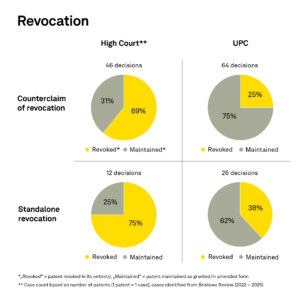
On revocation, the contrast is stark. For counterclaims for revocation, the UPC maintained 75% of challenged patents as granted or in amended form (64 decisions in total; 25% revoked entirely), whereas the High Court only maintained 39% as granted or in amended form (46 decisions in total; 61% revoked entirely). For standalone revocation actions, the High Court maintained only 25% of challenged patents as granted or in amended form (12 decisions in total; 75% revoked entirely), while the UPC maintained 62% as granted or in amended form (26 decisions in total; 38% revoked entirely).
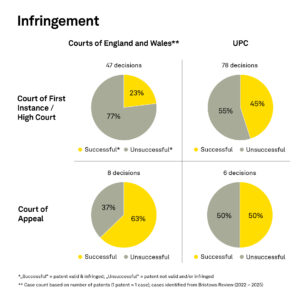
On infringement success rates — where „successful“ means the patent is found both valid and infringed — the gap at first instance is equally striking: claimants succeed in 45% of decisions (78 decisions in total) before the UPC Court of First Instance, compared to just 23% before the High Court (47 decisions in total).
The presence or absence of cross-examination may have a material bearing on outcomes in inventive step cases. Without cross-examination, a court may be inclined to give the patentee the benefit of the doubt on technical questions of obviousness; with cross-examination, expert evidence can be tested in ways that may make a finding of obviousness more likely.
The primary driver of the UK’s lower infringement success rate is its higher revocation rate — since a claimant must prevail on both validity and infringement, a more revocation-receptive environment will naturally depress combined success figures. It was also noted that the divergence may be partly due to the different technical focus of UK and UPC patent litigation: UK courts handle a substantial volume of pharmaceutical litigation where revocation rates have historically been very high, whereas the UPC has to date seen relatively little pharmaceutical litigation.
B. Judicial competition — is there a forum non conveniens?
Moderator: Prof. Dr. Tilman Müller-Stoy (BARDEHLE PAGENBERG)
Panelists: Tom Mitcheson KC (Three New Square), Kevin Scott (Philips IP&S), Dr. Corinna Lueg (Bayer Intellectual Property GmbH), Julia Bernatska (BARDEHLE PAGENBERG)
The second panel addressed the long-arm powers of the UPC and German courts as well as the competitive dynamics between the UPC and UK courts. A recurring theme was that some of the rhetoric about rivalry and judicial imperialism that has circulated in the media and in academic commentary is considerably overstated. There is no appetite on either side of the Channel to escalate tensions: UK courts and the UPC are, to the greatest extent possible, working constructively alongside one another on their own cases. The question is not which system „wins“, but how companies can navigate both to best effect.
Against that backdrop, the panel explored the territorial reach of UPC and German court decisions. The UPC’s competence is expressly limited to European patents, and the court cannot issue injunctions extending to US patents. Within its domain, however, it has already exercised long-arm jurisdiction in several decisions — setting the benchmark for future long-arm claims. The German Regional Court of Munich has also made use of its long-arm powers and issued a pioneering injunction covering 22 European countries in Bayer/Regeneron v. Formycon.
The doctrinal bases for long-arm jurisdiction under Brussels I bis — defendant domicile (Art. 4) and the anchor defendant principle (Art. 8) — are well established in the UPC case law. In contrast, if jurisdiction is based on the place of tort (Art. 7), UPC’s jurisdiction is limited to forum-state acts. What remains genuinely open is whether an anchor defendant may be a mere intermediary, a question that has generated the first-ever CJEU referral in this area, in Dyson v. Dreame.
Where long-arm jurisdiction is exercised over non-UPC or non-German patent portions before the UPC or German national courts, respectively, foreign substantive law applies, generating additional cost and delay. Notably, the UPC Local Division The Hague (HL Display v. Black Sheep) acknowledged an indicative effect of UPC law for non-UPC portions of a European patent, and the Munich Regional Court (Bayer/Regeneron v. Formycon) assumed the „lighthouse effect“ of the German Federal Patent Court on validity.
How UK courts would respond to a UPC injunction purporting to cover UK territory remains legally unresolved, and an anti-suit injunction from the UK cannot be excluded. Enforcement outside EU territory, including in the UK, generally requires separate recognition proceedings, except for disclosure of information necessary for calculation of damages, as outlined by the UPC Local Division Mannheim in Fujifilm v. Kodak. The practical difficulties of enforcement may ultimately render the jurisdictional debate moot.
On FRAND, global rate-setting and interim-licence disputes, UK courts bring deep experience and remain a leading global forum for rate-setting, with pool licence jurisdiction pending in Tesla v. Avanci and InterDigital. In parallel, the UPC is emerging as a credible complementary venue: counterclaims for FRAND rate determination have been held admissible in Panasonic v. Oppo and ZTE v. Samsung before the UPC Local Division Mannheim, and the admissibility of a proactive FRAND claim may be decided imminently in Sun Patent Trust v. Vivo. The InterDigital v. Amazon proceedings — running simultaneously before the UPC and UK courts — illustrate how the two systems are already in active, if complex, dialogue on interim licence disputes.
The UPC Patent Mediation and Arbitration Centre (PMAC) offers a further constructive option: mediation can run in parallel to UPC proceedings without causing procedural delay, and the question of how conduct during PMAC mediation may be weighed in a subsequent FRAND defence remains an important open point.
C. A transatlantic perspective
The event’s special highlight was a contribution by Kathi Vidal, Immediate Past Director of the USPTO. Charismatic, energetic, and genuinely inspiring, her address offered a high-level, authoritative US perspective on patent litigation in Europe: how the UPC and the UK system are perceived from the US and from the boardrooms of US-headquartered companies, what the strategic implications of the UPC’s rise are for global portfolio management, and what European practitioners need to understand about how the European systems are perceived from across the Atlantic.
[1] The cases were identified based on the Bristows Review of Patent Cases in the English Courts for 2022 to 2025, see https://www.bristows.com/viewpoint/publications/patents-review-of-the-year/; UK cases were counted by patent – as opposed to usual practice in the UK – to make numbers more comparable to the UPC.