Federal Court of Justice confirms Munich ruling in VoiceAge vs HMD
The Federal Court of Justice's Antirtust Senate has upheld the Munich Higher Regional Court's injunction against HMD. The court largely maintained its FRAND case law from Sisvel vs Haier I and II. To the disappointment of HMD and the European Commission, the court did not even consider referring the case to the CJEU.
27 January 2026 by Mathieu Klos

Around 40 observers — representatives of SEP holders and implementers — travelled to the Federal Court of Justice in Karlsruhe today to follow the hearing in VoiceAge vs HMD.
Expectations were high on all sides that the court might make fundamental changes to German FRAND case law. At the very least, many hoped the court would clarify its previous rulings. Some even anticipated that the Federal Court would now instruct lower courts to scrutinise the FRAND compliance of SEP holders’ and implementers’ offers more closely.
Dashed hopes
However, presiding judge Stefanie Roloff dashed these hopes at the outset of today’s hearing when she indicated that the court would likely uphold Munich’s injunction against HMD for infringing a VoiceAge-held EVS speech-coding patent.
The Antitrust Senate, with patent judge Hermann Deichfuß as rapporteur, showed little inclination to deviate from its previous Sisvel-Haier case law from 2020 and 2021. The Federal Court judges likely did not even consider a referral, as requested by HMD and the European Commission.
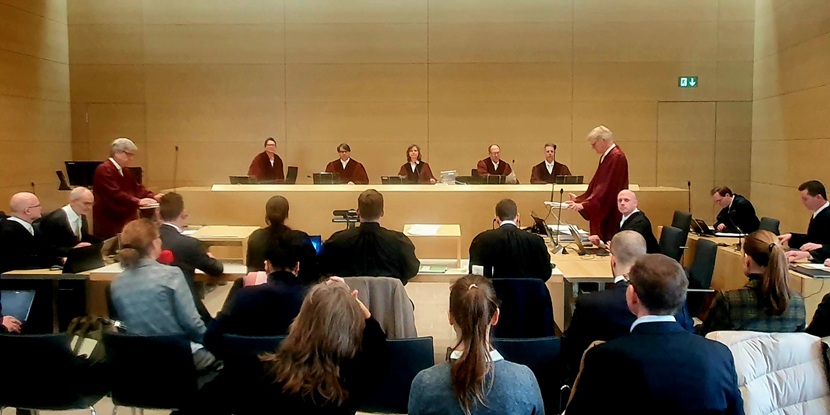
Federal Court lawyers Christian Rohnke and Rainer Hall exchange arguments before the panel at the Federal Court of Justice ©Mathieu Klos/JUVE
HMD’s lawyers and European Commission representatives tried until the end to persuade the judges to refer important open questions. They argued that too many unanswered questions remain in German FRAND legal discussions regarding the interpretation of the CJEU’s Huawei-ZTE judgment. These include whether the steps specified by the CJEU form a strict sequence, or whether courts like the Munich Higher Regional Court can prioritise examining individual steps.
Court hands down judgment
After a calm two-hour hearing, judge Rotloff concluded proceedings without the judges putting a single question to the representatives of VoiceAge, HMD, European Commission, or German Federal Cartel Office.
One lunch break and two hours later, the judgment in this legally complex case was already available. Munich Regional Court’s injunction against HMD, upheld by Munich Higher Regional Court, remains in place. The courts still consider HMD an unwilling licencee.
Among other things, the court criticised the fact that, during the many years of negotiations, HMD provided a security that was significantly lower than what would have resulted from its own licence offer.
Today’s ruling marks the third consecutive success for VoiceAge and its lawyers from Wildanger Kehrwald & Graf von Schwerin, as well as Bosch Jehle and Federal Court lawyer Christian Rohnke, against HMD.
In a press release, the Federal Court judges stated that following the CJEU’s Huawei-ZTE decision and its own two Sisvel-Haier decisions, the court maintains that Article 102 TFEU does not prevent a standard essential patent holder from enforcing its rights in court if the opponent’s behaviour indicates it is not genuinely willing to license.
No referral to CJEU
Regarding its refusal to refer the case to the CJEU, the court writes: “A referral to the Court of Justice of the European Union pursuant to Article 267(3) TFEU was not warranted. A national court is exempt from the obligation to refer if the question raised is not relevant to the decision, the Court of Justice has already interpreted the provision of EU law, or the correct interpretation of EU law is so obvious that there is no room for reasonable doubt.”
Furthermore, the Federal Court judges write: “According to the Huawei/ZTE decision, due consideration must be given to the specific legal and factual circumstances of each case. This is the task of the Member State court in each individual case, applying its national procedural law. Accordingly, it can be assumed without reasonable doubt that EU law (Article 102 TFEU) does not prescribe a fixed sequence of procedural steps that must be strictly followed in every case. The question of whether the amount of security to be provided by the defendant must be based on the patent holder’s licence agreement offer is irrelevant here because the security provided was significantly lower than the defendant’s own offer.”
A question of security
In the press release, the Federal Court judges comment indirectly on the amount of security that the implementer must deposit to demonstrate its willingness to negotiate. Munich Higher Regional Court had made this an important element of its new FRAND case law. The Higher Regional Court links the amount of the security deposit to the SEP holder’s offer. The Federal Court made it clear today that a security deposit below the implementer’s own FRAND offer is likely insufficient.
In their written judgement, expected in a few weeks’ time, the Federal Court judges may provide guidance on how high a security deposit must be.
Today’s ruling will primarily please SEP owners. For the time being, there will be no change to the German practice of first examining misconduct in the CJEU’s so-called FRAND dance. The German courts of first instance will likely not examine the FRAND conformity of licence offers from SEP owners and implementers without good reason.
For more background on the case and advisors, see our case preview.
